
PM Spirits

Provider of Geeky Spirits

Financial Times,Ch,Ch,Ch,Ch,Château Arton

Financial Times: Make mine a Stinger… why cognac cocktails are trending

Armagnac, Brandy, Cognac, cognac, PM Spirits, Financial TimesNicolas Palazzi

Forget the Spicy Margarita – here’s what the mixologists will be ordering at the bar

The Spicy Margarita is everywhere – in plenty of bars I know it now accounts for half of all drinks sales. But what would we all be drinking if the bar world’s top tastemakers had their way? In my survey, brandy won by a landslide, with cognac, Armagnac and apple-based calvados all getting plenty of votes. “Cognac is the king of spirits, it’s got so much going on,” says Jake Burger, proprietor of Portobello Star in London’s Notting Hill. He recommends the 19th-century Cognac Cocktail – essentially an Old Fashioned made with brandy – “which is what we’d all be drinking today if phylloxera hadn’t wiped out all the French vineyards and turned America into a whiskey-drinking culture”. For a really authentic Cognac Cocktail, he says, use Sazerac de Forge & Fils cognac, which is modelled on pre-phylloxera recipes (£121, masterofmalt.com). Under the £80 mark he also likes Merlet XO, Fanny Fougerat Iris Poivré XO and Prunier VSOP. Armagnac comes highly recommended by Sipsmith co-founder and master distiller Jared Brown and Sebastian Tollius, beverage director of Eleven Madison Park’s new Clemente Bar. “It’s rustic, full of character and versatile,” says Tollius. He favours the small batch bottlings by French specialist PM Spirits (from $62.50, pmspirits.com). “Perfect [as a sub for whiskey] in classics like Manhattans or as a stand-in for cognac in a Vieux Carré.” Ennismore’s head of bars Robert Simpson makes the case for calvados, “which has flavours from crisp fresh fruit through to apple strudel”. Punch editor Talia Baiocchi agrees: “I love a simple calvados and tonic.”
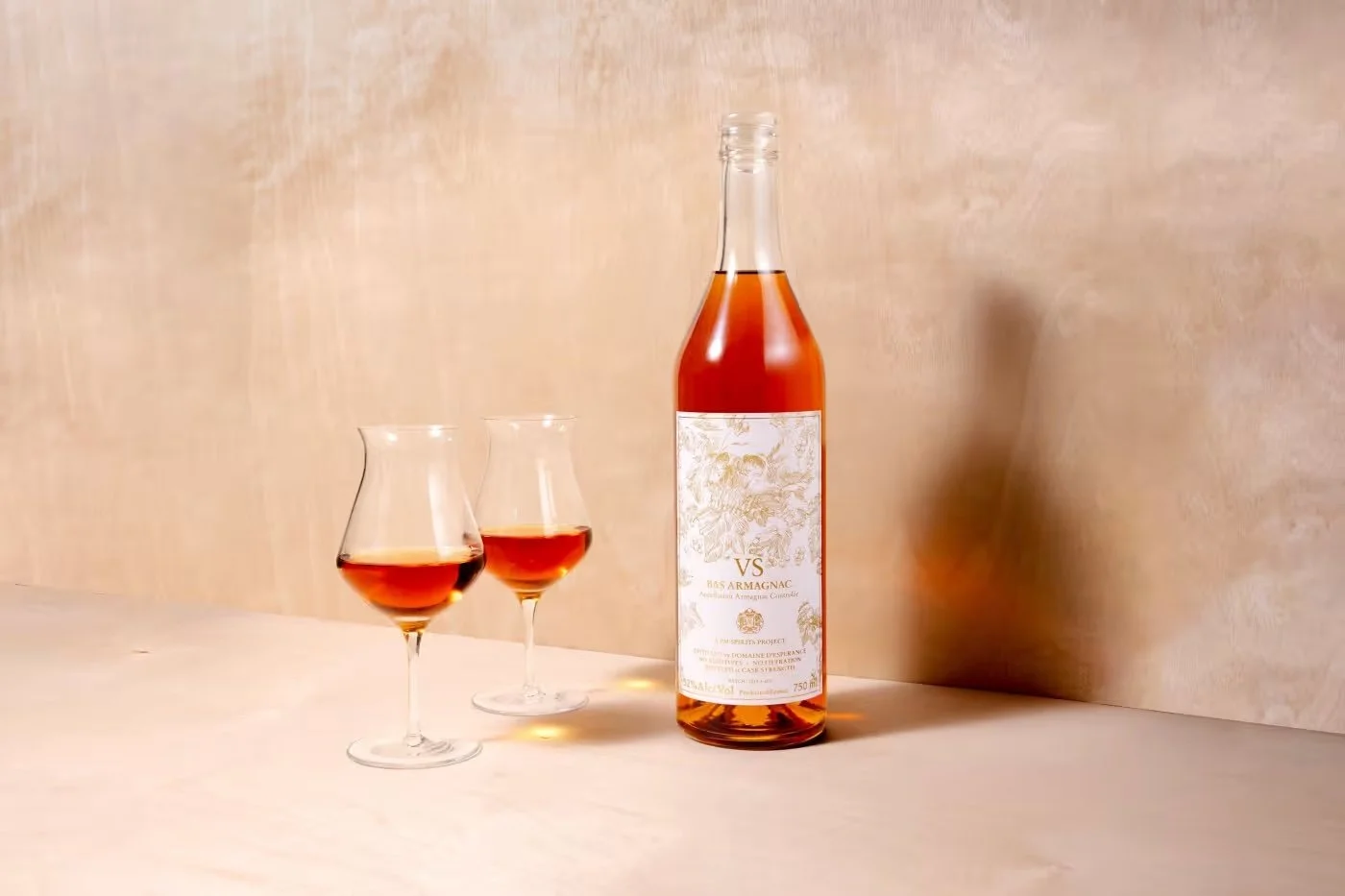
PM Spirits VS Overproof VS Bas Armagnac, $62.50 for 75cl, pmspirits.com

Liqueurs were another strong performer – and particularly crème de menthe. Which would have shocked me had I not, uncharacteristically, found myself ordering a Stinger in the Spy Bar at Raffles London just recently. This minty digestif sees cognac laced with white mint liqueur; it’s typically shaken and served “up” in a coupe or over crushed ice. Spy Bar makes its own After Eight-infused crème de menthe, but Tempus Fugit (£31.50 for 70cl, bbr.com) is also excellent. Another liqueur due a revival, according to drinks writer and co-owner of the Pacific Standard in Portland, Oregon, Jeffrey Morgenthaler, is the monastic nightcap Bénédictine DOM (£31.25, thewhiskyexchange.com) – he favours the “sweet, peppery, herbal French liqueur” in a rye whiskey-based La Louisiane cocktail. NoMad London’s Leo Robitschek, meanwhile, pleads the case for amaretto, particularly in a sour. If there’s a common theme in all of this, it’s the after-dinner drink. Perhaps 2025 will see the red-hot Margarita make way for something a bit more smouldering. 

Stinger

Some might find this old-school 3:1 formula a bit heavy on the crème de menthe. If in doubt, start with less and then work your way up.  60ml VSOP cognac or armagnac 20ml white crème de menthe (such as Tempus Fugit) Method: Shake with ice and then either strain into a cocktail glass, sans ice, or serve over crushed ice in a rocks glass. 

https://www.ft.com/content/a8fb1c8f-eeb2-4c4a-8c16-6fe4b6963b97

Everyday Drinking: Is Armagnac The New Bourbon? Or Is It The New Mezcal?

Armagnac, Brandy, Château Arton, Nicolas Palazzi, L'Encantada, DOMAINE D’AURENSEN, Domaine d’EsperanceNicolas Palazzi

An exercise in reading beyond the headline. Plus, my picks and tasting notes on 16 bottles for your holiday splurge.

People often ask me, “What’s the difference between Cognac and Armagnac?” (Yes, I exist in incredibly nerdy spaces). To be honest, there as many similarities as differences. They’re both brandies made from grapes, often the same grapes. They’re both made in southwest France, less than three hours drive from one another. At the top end, they’re both expensive. But there are key differences, both technical and cultural. Below, I’ve posted my Armagnac 101.

More than anything, Cognac is bigger than Armagnac. Much bigger. Cognac represents a $4 billion market global market, with 225 million bottles sold each year. Meanwhile, Armagnac sells around 5 million bottles in a year. That means you don’t have huge multinational players like Hennessy or Rémy Martin in Armagnac. Instead, it’s mostly smaller family estates. Most don’t even own stills, but rely on itinerant distillers going from house to house after harvest and fermentation. There simply isn’t as much Armagnac in the world.

That scarcity and local grassroots production is why people often make this analogy: Armagnac is to Cognac what mezcal is to tequila. In the craft spirits world—where mezcal has cool, trendy, insider buzz—that’s not a bad place for Armagnac to be.

That seems to be what some in the industry are banking on. For instance, in late 2021, the venerable brand Marquis de Montesquiou, one of Armagnac’s largest producers, was bought from Pernot Ricard by Alexander Stein, the entrepreneur who created Monkey 47 Gin—which Stein had previously sold to Pernod Ricard. “He thinks Armagnac is the new mezcal,” said Jean-Francois Bonnete, the president of BCI, which imports Marquis de Montesquiou. It will be interesting to see how the brand, which has slipped in quality, will evolve under Stein.

Meanwhile, Stein isn’t the only industry bigwig who’s invested in the region. And a some of the other players don’t see Armagnac as the new mezcal. Rather, they’re banking on it being the new bourbon.

A few years ago, Raj Bhakta, one of the founders of Whistle Pig whiskey, bought the entire stock of a traditional Armagnac house, Ryst Dupeyron. In 2021, Bhakta told me that he’d “transferred the majority of it to Vermont,” where it would be finished in Islay whisky barrels. He released the blends a barrel at a time. “Technically it is Armagnac, but I’m not calling it Armagnac,” Bhakta told me at the time. Still, all of his promotional material clearly mentions Armagnac as the spirit’s place of origin.

Bkakta is clearly trying to appeal to a certain kind of American whiskey drinker, to blow them away with a 50-year age statement on the label. “The American whiskey drinking is dying for something new. He just doesn’t know it yet,” he told me in 2021. But Bkakta made clear he has little intention of educating his bourbon bros on Armagnac when he declared: “Armagnac just doesn’t have much brand value.” I mean, that’s some serious hubris there. But I guess it’s no less arrogrant than taking something a family aged for five decades in the French countryside and sticking in a Islay whiskey barrel for a few months to, ahem, “finish” it.

I’ve written before about this whiskey-fication of Armagnac. I’m very clearly on the record as saying this is not a good thing.

Nicolas Palazzi of PM Spirits, which imports a number of top Armagnacs, summed up the current market like this:

“There’s more Armagnac being sold, but it’s a very specific kind of Armagnac sold to a specific kind of buyer. We’re talking about Armagnac that’s very extracted, heavier on the wood, more powerful, more vanilla. So it’s not very different than the whiskey that people are drinking. We’re selling a lot less classical Armagnac.”

In other words: Armagnac that tastes like bourbon. Still the big question for Armagnac in the U.S. is whether or not whiskey drinkers—tired of ridiculous bourbon prices—will embrace brandies they likely can’t pronounce.

When I think and talk about Armagnac, I am a million miles away from the whiskey market. Gascony is a rustic, agricultural place of small towns that’s famous (or infamous) for the ducks and geese raised for foie gras (more than once been I’ve been served a “salad” in Gascony that was literally all meat). I posted recently about my pilgrimage to some revered small estates. Armagnac is a fragile place, and there is legitimate worry about whether it can handle becoming the new bourbon or the new mezcal.

We love the allure of drinking from decades-old barrels that a négociant—a treasure hunter—has discovered and procured from an elderly grower, or a widow. But those barrels often represent the end of a multi-generational wine-growing family. The numbers don’t lie: In 50 years, the total vineyard area of Armagnac has shrunk from 10,000 to 2,000 hectares. “This tradition is dying,” says Lili de Montal, at Château Arton, with around 40 hectares in Haut-Armagnac. “It’s not an overstatement to say it’s a disaster.”

A few weeks ago, I went to a tasting of Château de Laubade in New York, hosted by Denis Lesgourgues, whose family has run the estate for three generations. It was a small group, mostly people from the trade, and I thought Lesgourgues’ presentation was a good model for how Armagnac might move forward into an uncharted market.

Among the samples, we tasted an experimental bottling made from the rare plant de graisse grape, as well as Laubade’s new 21-year-old expression. That age statement is itself not common. “You don’t see a lot of age statements in Armagnac,” Lesgourgues said, adding: “We’ve been thinking about whiskey drinkers. The price of 21-year-old whiskey is very high. So we feel this is a chance for whiskey drinkers to try a 21-year-old Armagnac.”

I’ve known Lesgourgues for about a decade, and back in 2021, he and I had a disagreement over a Armagnac he released that was finished in Bardstown bourbon barrels. His new 21-year-old feels like a much better approach to meet the whiskey drinker with an Armagnac that’s still got the classic profile. (I recommend it below in my bottle picks).

After the tasting, everyone in attendance split into groups and we blended our own Armagnac from the 2008 vintage from aged samples of four specific grapes: ugni blanc, baco, colombard, and plant de graisse. Besides being fun (my team of course made the best blend; I got an embossed certificate!) the exercise focused attention on the raw ingredients, the grapes and the wine. It drove home to the people in attendance just how different Armagnac is from nearly any other spirit.