PM Spirits

Provider of Geeky Spirits

Interview,Imbibe,Imbibe,Imbibe,Imbibe

Imbibe: Passion Project Nicolas Palazzi and the art of selling to 50 people

Imbibe, Nicolas PalazziNicolas Palazzi

We’ve never had a market,” says Nicolas Paul-Marie Palazzi, Miami-based owner of PM Spirits. “Fifteen years ago there wasn’t a market, and there’s no market now.”

This seems an odd thing for the founder of a successful spirits-importing company to say. But it’s true in one way: Palazzi doesn’t really identify markets; he identifies bottles. He finds spirits he loves, brings them into the country, and then goes looking for the handful of people who will appreciate them, too.
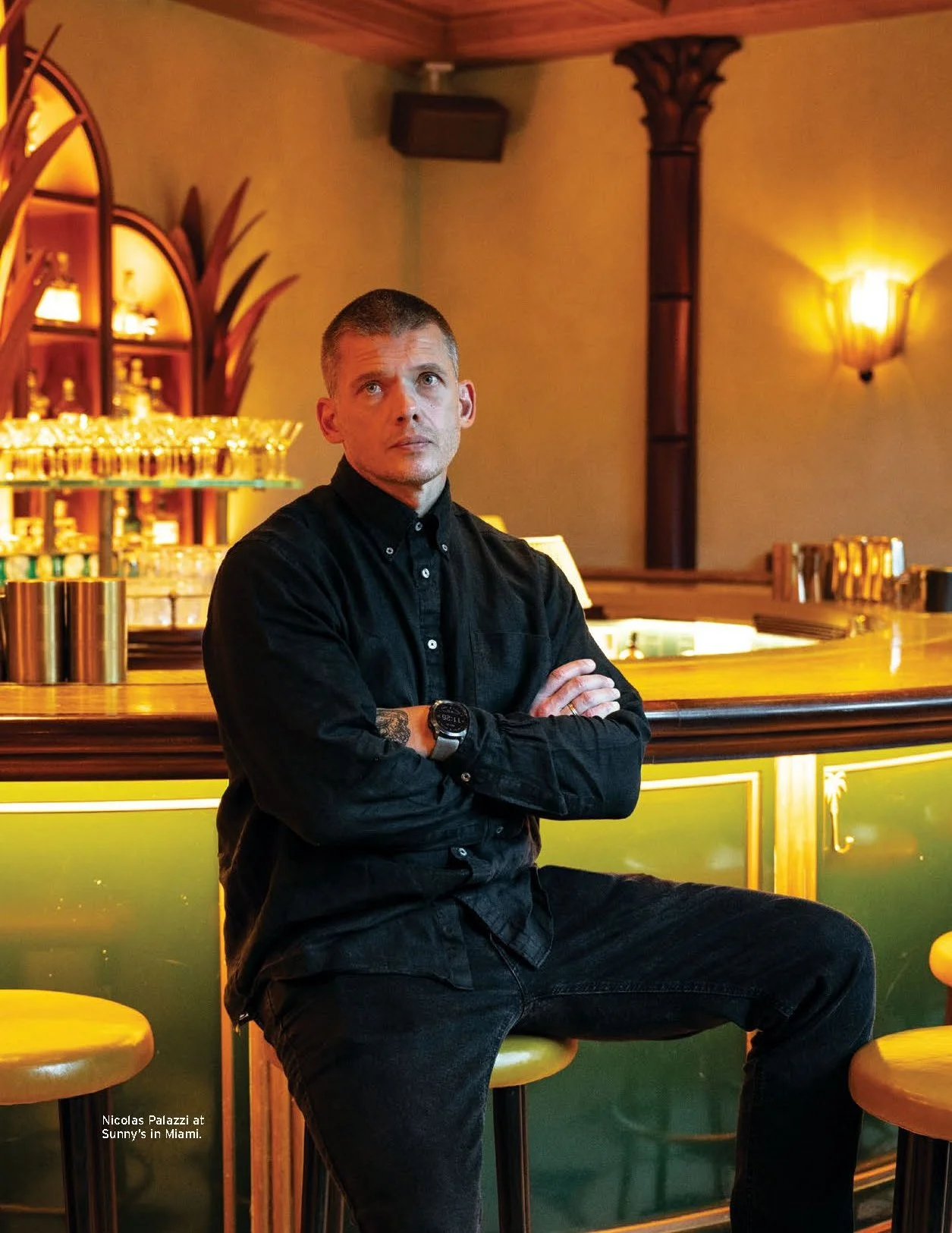
Photo by DAVID SALAZAR

Palazzi, who moved to New York from his native France in 2004, has emerged as one of the most admired spirits importers among aficionados and collectors, almost to the point of cultishness. His portfolio features outlier Cognacs, Armagnacs, single-malt whiskies, and big, funky rums. These include unicorns like Jacky Navarre Cognac, L’Encantada Armagnac, and Hampden Estate rums.

“The French are often the most traditional, and they like rules, whether it’s cheese or honey or spirits or whatever,” says Monique Huston, vice president of spirits portfolio at Winebow, an importer and distributor of wines and spirits. “Nicolas just kind of went anti-French.”

Palazzi was born and raised in Bordeaux, where familiarity with fine wines and brandy is all but mandatory. His mother’s family makes wine with their small business in Côtes de Bourg, and one of his grandfather’s closest friends was a well-regarded Cognac distiller. “At Sunday family lunches at my grandparents’ house,” Palazzi recalls, “we’d finish with Cognac made by this gentleman.” Palazzi wasn’t immediately drawn to the world of beverages. He left home to study engineering, and, after engineering school, worked several years as an environmental engineer for the French national electric utility company EDF. When a friend invited him to visit New York City, his life took a new trajectory. He left his unsatisfying job, moved across the Atlantic to join his friend (now his wife and mother to their two children), and found a new job managing a medical research lab. He had a respectable technical career but still didn’t feel content, and he eventually realized that he should build a life around something he actually cared about. “I would get up in the morning and just feel upset for no reason,” he says. “It wasn’t healthy.”

He considered his options. “My basic thoughts were, what are the things that I genuinely like to do?” he says. “And I liked wine and spirits.”

His interest led him first to hanging out, then working on weekends at Jean-Luc Le Du’s boutique wine shop in Manhattan’s West Village. He sharpened his knowledge of wine through seminars, blind-tasting groups, and connections with the sommeliers who patronized the shop.

New York impressed him with its wide diversity of available wines, especially compared to Bordeaux. He was particularly drawn to the bottles from smaller, family-run vineyards. But he found the spirits shelves lacked that depth and were dominated by larger, corporate brands. Palazzi’s instincts told him that New York would welcome curated, lesser-known spirits. So he quit his laboratory job and took his first, tentative steps into the beverage-importing business.

The standard advice for building a successful business is this: Identify demand in a market, then satisfy it. Palazzi didn’t follow that approach. His business model, if it can be called that, was to seek out spirits he liked—made as naturally and with as little intervention as possible—and then strike an import deal with the producer. Put the bottles on the store shelves, and assume fellow lovers of spirits would eventually find and buy them. While his plan was vague at best, he did have a short list of contacts, ranging from producers he knew in France to buyers he’d met at Le Du’s wine shop.

Palazzi flew home to France and visited his grandfather’s friend, the Cognac maker, who became a mentor. “His operation was super tiny, just one dude, but he was real artisanal and really good at what he did,” he said. “I approached him and said, ‘I like spirits. And I’m thinking that I would like to do something around it, and I don’t know anything about it, really.’”

With his mentor’s advice and introductions to a few other distillers, Palazzi launched PM Spirits, named to honor his father, Paul-Marie Palazzi. His first import was Guillon-Painturaud Hors d’Age, a Grande Champagne Cognac, provided by his family’s friend. Back in New York, he took to the streets with bottles in a bag, talking with restaurateurs and liquor shop owners one at a time, hoping to convince them to stock his product. One agreed, then another, and in time he sought out other spirits worthy of attention, including his second import, a Cognac from the house of Paul Beau.

He learned the mechanics of importing the hard way: by screwing up. He underpriced bottles and sold them at a loss. He bought inventory without understanding cash flow. He learned about duties, invoices, and the peculiar financial limbo in which an importer pays suppliers and the government long before customers pay him. “I’ve done a lot of things that did not work out,” he says. “But none of them were fatal.”

A central problem was finding someone to distribute these obscure bottles—a common lament among smaller importers. So Palazzi did what became a recurring feature of his career: When the conventional system didn’t work for him, he worked around it. He began distributing his own spirits in New York, selling bottles himself. To this day, PM Spirits consists of two businesses: a New York wholesale operation, in which his company self-distributes the products in the state, and an importing business that supplies distributors throughout much of the rest of the nation. (Palazzi and his family moved from Brooklyn to Miami in 2019.)

Bit by bit, drinkers started to pay attention. Palazzi returned to France and discovered Armagnacs and Calvados that he thought worthy of attention, and began importing those as well.

He visits each distillery to assure himself that it’s managed by artisans, not accountants. “We meet the people—we need to be like-minded individuals,” Palazzi says. It’s telling that his online directory of imported products often features pictures of the producers, not shots of stills or barrel houses. “It’s meaningful,” says Kate Perry, U.S. market manager for La Maison & Velier, who met Palazzi in 2014 and has partnered with him in importing and marketing his spirits in the U.S. “They’re real—real farmers, real people, real communities. A very personal thing, which is not often the case with spirits brands.”

His explorations have taken him far beyond French brandies, and his portfolio has expanded to include whiskies, rums, agave spirits, eau de vie, and liqueur—all ticking the boxes Palazzi has set out, foremost among them being that he likes drinking them. Palazzi has also partnered with likeminded others in collaborative ventures. “We see if we can work together and do something that’s cool and tastes very good, and that I can afford,” Palazzi says.

Perhaps the best known of his “collabs” is the partnership with Equipo Navazos, a boutique sherry producer in Spain. Palazzi came across this sherry at a wine dinner organized by Levi Dalton in New York, and later toured Spanish bodegas with co-founders Eduardo Ojeda and Jesus Barquin. Ojeda and Barquin took an approach to sherry similar to that embraced by Palazzi: find and market excellent, distinctive sherries crafted by independent producers.

The trio soon partnered on a line of spirits, starting with Spanish brandy that had been aged in sherry casks in hot, dry Spain—a process that transformed a middling brandy into something worthy of a snifter. They later applied the same method to other spirits, including gin, Spanish whiskey, and rum, all sold under the Navazos-Palazzi label. Their rum in particular attracted fans. A Caribbean rum aged five years in ex-bourbon casks and then further in oloroso sherry barrels for more than a decade, it was praised by critics for its notes of quince, walnut, and caramelized roasted meat. In one review, the taster concluded that the rum evokes a full, festive meal in a glass. Palazzi has also released his own branded line of PM Spirits, which includes Cobrafire, launched in 2016. It’s an unaged Armagnac, produced with Domaine d’Espérance, sold as an eau de vie de raisin.

A “drink less, drink better” ethos has spread in recent years, as spirits fans consume less but are willing to spend more on higher-caliber bottles. In some ways, the buying public has caught up with Palazzi, who has become an inadvertent avatar of this movement. There is something almost stubbornly old-fashioned about his approach. It’s not exactly a recipe for building a mass market. But that’s never really been the point. “I don’t have any marketing money,” Palazzi says with a shrug. Finding great spirits is easy, he says. Getting people to try them (and, importantly, buy them) is much harder. “So the only thing that I can do is put a product on the market that looks cool and tastes very good, then try and convince people it’s worth their attention and their money.”

“I think it’s gotten to the point that putting the PM Spirits stamp on something says Nick has tasted this,” says Huston, “and that means it’s really good quality. Maybe his audience is 50 people.” And she appreciates that Palazzi’s approach is essentially: “How about I bring this beautiful thing in for those 50 people?”
Radio Imbibe Episode 46: Nicolas Palazzi of PM Spirits

Armagnac, cognac, interview, Nicolas Palazzi, ImbibeNicolas Palazzi
Episode 46: Nicolas Palazzi
Radio Imbibe

The cover story of our March/April 2022 issue features brandy, and for this episode, we wrap up our coverage of the spirit with Nicolas Palazzi. Born in Bordeaux and now living in Brooklyn, Palazzi is the founder of PM Spirits, an importer and distributor of specialty spirits, including Cognac, Armagnac, and Calvados. For this episode, we talk with Palazzi about his search for memorable barrels of brandy, what he looks for in great brandies, and his work to bring these spirits to an American audience. 

Radio Imbibe is the audio home of Imbibe magazine. In each episode, we dive into liquid culture, exploring the people, places, and flavors of the drinkscape through conversations about cocktails, coffee, beer, spirits, and wine. Keep up with us on Instagram, Twitter, and Facebook. And if you’re not already a subscriber, we’d love to have you join us—click here to subscribe.  

https://imbibemagazine.com/podcast/radio-imbibe-episode-46-nicolas-palazzi-pm-spirits/

BRANDY - From Cognac to California, the historic spirit’s influence runs deep.

Interview, L'Encantada, Cognac Frapin, cognac, Cognac, Brandy, ImbibeNicolas Palazzi

JUICY FRUIT

From vineyard or orchard to bottle and bar, brandy’s influence runs deep.

Cognac, Armagnac, applejack, schnapps—in whichever form brandy is found, these spirits made from fruit have no parallel in the glass. While whisk(e)y, tequila, and rum get lots of love these days (deservedly so) from cocktail lovers and spirits drinkers, brandy is evolving and emerging on its own terms, slowly building a fan base to take this timeless spirit into the future.

We’re taking a closer look at today’s world of brandy—the ways it’s made and appreciated around the world, the details behind its complex production, and the reasons it should be the next bottle you reach for when cocktail hour rolls around.

Nicolas Palazzi

Bordeaux-born and Brooklyn based, Palazzi is the importer behind PM Spirits, specializing in independent spirits such as L’Encantada Armagnac, Cognac Frapin, and Cobrafire eau-de-vie de raisin.

“Something that’s really cool is when you’re in a brandy cellar, with 50, 60, 100 casks in front of you; even if they’re from the same batch of distillation, every cask is its own world. You could taste 15 casks distilled the same day, and you’ll find tremendous differences between them—whereas something like bourbon would be very consistent. There’s so much aroma and flavor profile available in brandy. If someone thinks Cognac is just one thing and it’s boring or they don’t like it, I assure you, I can find a single-cask Cognac that’ll blow your socks off. It’s a world that deserves to be discovered, for sure.”

https://www.dropbox.com/s/mel2ts24hjap0oq/MA22-Imbibe-Brandy.pdf?dl=0

Commanders and Cocktails!

Best of, cocktails, Interview, Jacky Navarre, Laurent Cazottes, Nouaison Gin, Pere Labat, NETA, Navazos PalazziNicolas Palazzi

Welcome to COMMANDERS AND COCKTAILS!

Some folks know that before I was able to work full time in comics, I worked in a variety of jobs in the wine and spirits field. And the final one of those was for my good friend Nicolas Palazzi’s PM Spirits. Just COMMANDER IN CRISIS, PM works its ass off to be unique, to create trends rather than follow them, and offer craftsmanship and creativity in a field that has, at times, been known to stagnate. I wouldn’t be where I am, writing this, without the support of friends and employers like Nicolas.

So, I thought it would be fun to turn the tables and feature him and his crew below, offering some in-universe cocktail recipes to honor the heroes of the Crisis Command. In the paraphrased words of a greater power, when I left PM I was but the learner. Now, I am the master (well, or closer to it)! And either way, I’m happy to return the support with a feature here, and invite creatives from other fields into the world of the Crisis Command.

STEVE ORLANDO

Commanders in Crisis, Vol. 2

PRIZEFIGHTER

2oz Navazos Palazzi Malt or Corn Whisky
0.75oz La Quintinye Rouge Vermouth
0.5oz cherry liqueur
2 dashes Angostura Bitters
Barspoon Absinthe

Instructions:

Build in rocks glass over ice and stir briefly. Garnish with burnt blood orange peel.

SEER

2.5oz Neta Espadin Destilado de Agave
0.5oz La Quintinye Dry
Barspoon of olive brine
Pinch of salt

Instructions:

Build in mixing glass over ice and stir until cold. Strain into chilled cocktail glass and garnish with 3 green olives on a pick.

SAWBONES

2oz Père Labat Rhum Blanc 59%abv
4 dashes Peychaud’s Bitters
Sparkling mineral water

Instructions:

Pour Rhum into highball glass over ice. Stir briefly to chill. Top with sparkling water and bitters. Stir once again to combine. Serve without garnish. or Neat pour of Jacky Navarre Cravache d’Or Cognac

ORIGINATOR

1oz Nouaison Gin by G’Vine
0.75oz lemon juice
0.5oz Laurent Cazottes Folle Noire
0.5oz simple syrup
2oz sparkling wine

Instructions:

Build all ingredients except sparkling wine in a shaker and shake lightly to combine. Add sparkling wine to the shaker and strain into chilled cocktail glass. Garnish with a spring of fresh lavender.

FRONTIER

2oz Père Labat Rhum Blanc 40% or 59% abv - Choose your strength
0.5oz Laurent Cazottes 72 Tomatoes

Instructions:

Build in mixing glass over ice and stir until cold. Strain into chilled cocktail glass and garnish with freshly ground black pepper.

COCKTAIL CREDITS: David Yi-Hsian Dong and Nicolas Palazzi of PM Spirits.

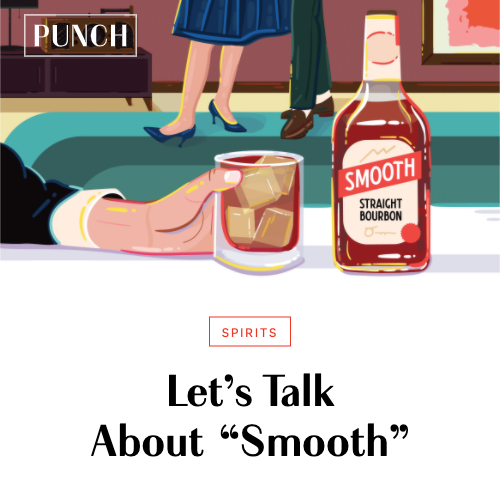
Let’s Talk About “Smooth”

Interview, Nicolas Palazzi, PM SpiritsNicolas Palazzi

It may be the most ubiquitous descriptor in drinks. Is it also the most reviled?

The Bordeaux-bred, Brooklyn-based spirits importer Nicolas Palazzi traffics in stories—of the alchemists along the river Charente, whose Cognacs capture the essence of the surrounding vineyards and microbiota; of the artisans in northwestern France, whose Calvados express the nuance of dozens of cider apple varieties via a single bottle. Palazzi’s company, PM Spirits, identifies itself as a “provider of geeky spirits.” Part of the job, indeed, involves geeking out, luxuriating in the details and conveying them to potential buyers. It’s an arrangement that hinges on dialogue, governed by the imprecise linguistics of wine and spirits. Descriptors and analogs form bridges to connect one’s palate and sensibility to another’s. But all it takes is one word to dissolve the connection entirely.

“If their reaction is, ‘Oh, that’s smooth,’ it just tells me that I probably have not identified my customer as well as I thought I had,” Palazzi tells me. “I’m not upset at the person saying ‘smooth.’ I’m upset at the waste of life—it’s basically a sign that says ‘You just wasted your time.’”

Harsh words for a word that literally signifies the opposite. But language matters. The lingua franca of booze is inherently nebulous, and it requires calibration. A trained nose and palate can instantaneously identify a range of aromas and flavors and free-associate memories and feelings, which all become pinpoints tracing a constellation, giving shape to a ghost. The term “smooth” effectively erases any point of reference. Even as an adjective, “smooth” functions as a verb: It is the buffing out of character, the sanding down of the distinctions that make great spirits great. In the quest to triangulate the specific qualities of a spirit, “smooth” instead forms a binary of acceptability. It is a value judgment on whether or not one finds the spirit drinkable, one that can easily be impressed upon an unwitting consumer. This is exactly why the term is so ubiquitous in the marketplace, and—for decades, if not centuries—a red flag among connoisseurs.

https://punchdrink.com/articles/lets-talk-about-smooth-whiskey-spirits-tasting-notes/

Geeky Cocktails: Meet the Man Behind the Artisanal Spirits Movement

cognac, Navazos Palazzi, PM Spirits, InterviewNicolas Palazzi
nicholas-pilazzi-cocktail.jpg
 
VOGUE_LOGOsvg.png
 

Geeky Cocktails: Meet the Man Behind the Artisanal Spirits Movement

When Nicolas Palazzi quit his day job as a chemical engineer in 2008, the spirits world got a little more interesting. The French native had moved to New York City to manage a medical research lab, but brought with him a curiously intense affinity for rare-cask Cognac. Dismayed by the lack of like-minded, handcrafted products on the market in the U.S.—where the spirits scene was still largely focused on big-name brands despite a booming, more intelligent cocktail culture—he set out to learn the business from the ground up. He officially launched his import company, PM Spirits, in early 2011 with just two independent Cognac producers (Paul Beau, Guillon-Painturaud) and six products. Now his book includes profound Spanish brandies, grappa from famed Sicilian avant-gardiste Frank Cornelissen, and Mexican Fernet (a bitter liqueur).

Palazzi is being lauded by beverage authorities nationwide as the go-to for distillates of character and terroir, and Palazzi’s unique bottles now line the shelves of restaurant and bar greats like The NoMad in New York City, Jack Rose Dining Saloon in Washington, D.C., and Scopa Italian Roots in Venice, California. Had an interesting digestif you’d never heard of before while out dining? That might have been made possible through Palazzi’s meticulous sourcing. He talks to Vogue.com about cocktails, “geeky” spirits, and the six bottles he’s most excited about now.

The tagline on your website is “provider of geeky spirits.” What does “geeky” mean in the spirits world?

When it comes to spirits in general, one doesn’t buy a product, one buys a brand. They buy the marketing and the status that the label conveys, but they don’t have a gauge on the true quality of the stuff inside the bottle, how it was made, who made it, and why it tastes the way it does. So by “geeky,” we mean the other stuff. It’s made by real people. It has an actual flavor profile that is specific to the place in which it’s made and the ingredients it’s made from. It’s not sweetened to death, artificially colored, or made to be as innocuous as it can be.

From that perspective, it seems to be as much about supporting the little guy as it is about supplying cool products.

It absolutely is. We want them to keep doing what they’re doing. When you start working with somebody, and they’re distilling out of a shack or their house is run-down, and you come back a year and a half later and see that they’ve made improvements. . . I’m not saying it’s 100 percent because of what we’ve done, but there is something rewarding about working with real people and the fact that the money spent buying these products can go toward their living and the creative process as opposed to feeding some giant company. I have nothing against big companies, but that makes it more meaningful to me. And the other result is that we’re educating people; we’re getting the authentic stuff to the people who will care about it. We’re showing them what these spirits used to taste like before mass marketing existed and can still taste like today.

What is a typical reaction of someone tasting spirits in your portfolio who is more used to tasting name-brand products?

People are not sure what to expect. A lot of people start out thinking that they’re doing us a favor by tasting these products that they’ve never heard of before, but they end up realizing that there’s a world of difference. I had one buyer who thought he didn’t like Cognac, then after one taste of the Paul Beau VS, he lit up. He was all, “Oh, wow, that’s really interesting,” and, “That’s a set of aromas and flavors I’ve never experienced before.”

There’s something extra that happens in the brain with the sensory experience of taste. When you taste something new and you love it, there’s an emotional connection that takes place. At that point, the person is not likely to forget it. They know you’re not fooling around and will want to see what else you have in your bag, even if it’s not something that will appeal to their particular clientele. They know you’re not wasting their time.

Would you say that the movement toward artisanal spirits is picking up speed, like what we saw happen to the craft-beer category?

It has definitely changed over the last six or seven years. Before, nobody cared, really. If you take bourbon as an example, you used to be able find anything you’d want and more on the shelves for a lot less money because people just didn’t know about it. And now certain bourbons are unavailable and allocated. Spirits are becoming cool. Drinkers have started paying more attention to what they’re drinking. I think that’s good news for everyone involved.

What is the coolest cocktail that you’ve encountered made with one of your spirits?

In Texas, I saw a sidecar made with a single-cask Cognac from a producer named Gourry [de Chadeville] that I brought in last year. This Cognac is distilled in a wood-fired pot still and is 64.3 percent alcohol, so that is a pretty kick-ass sidecar. You can’t drink too many of them! And at Cane & Table in New Orleans, they’re making a daiquiri with a rum I sourced in Spain from the sherry producer Equipo Navazos. It’s a bold daiquiri and is totally delicious.

What’s the latest addition to your portfolio that you’re most excited about? The thing that we don’t know about yet but will?

Calvados! I was lucky enough to be introduced to Eric Bordelet, the cider-maker in Normandy. It turns out the guy has been distilling for a number of years but never released anything. He’s doing single-cask full-proof unfiltered Calvados, distilling from both his cidre and his poiré (pear cider). Plus, his mentor was Didier Dagueneau, the famed Pouilly-Fumé winemaker, so everything is aged in ex-Silex casks from Dagueneau. It’s incredibly cool and will be available stateside in the beginning of 2016.

Intrigued? Here are six unique bottles Palazzi recommends adding to your bar (or gifting a very good friend):

Navazos-Palazzi Double Barreled Cask Strength Spanish Rum
A 100 percent molasses-based rum from the Antilles. Dark, meaty, with a nuttiness derived from the Oloroso sherry cask it ages in for more than ten years. Finishes bone dry. Only 1,500 bottles produced per year.

H. Beudin Single Cask 18 Year Calvados
Calvados with a kick, bottled at full proof. Gives a sense of what the pure stuff tastes like when sampled from a cask. Selected by star cider-maker Eric Bordelet.

Gourry de Chadeville Grande Champagne Cognac
One-man operation led by Pierre Goursat Gourry on nearly 25 acres of vineyards in Grande Champagne. A young, bold Cognac reminiscent of ripe apple and smoke, it spends seven years in an ex-first growth Sauternes cask.

Domaine d'Aurensan 1975 Single Cask Armagnac-Ténarèze
Like a vintage-dated Armagnac on steroids, with zero sugar, zero water, and zero coloring added. Distilled by the Rozès family. Mature flavors of dried prune, leather, and earth, with a seemingly endless finish.

Laurent Cazottes Poire Williams Eau-de-Vie
Distilled from organic pears dried to concentrate their flavor and then the pits, seeds, and stalks removed. Only 200 half-bottles of this Poire Williams come in to the U.S. each year.

Frank Cornelissen MunJebel Rosso Grappa
What happens when Sicily's most emblematic natural winemaker makes grappa. Distilled in a wood-fired vapor still from volcanic Mt. Etna’s indigenous Nerello Mascalese grapes.

https://www.vogue.com/article/man-behind-artisanal-sprits-top-picks