
It was at the end of a tasting at Eli’s Mezcal Room, an underground mezcal tasting experience located in a local man’s New York apartment, when host “Eli” (not his real name) pulled out one final bottle he thought might interest me: an unlabeled plastic water bottle he had suitcased back from Mexico. It was extraordinarily aromatic and I could smell its vegetal, medicinal notes the second the Poland Spring’s lid was unscrewed. It likewise had a rich, intense, burning flavor — no surprise as it was nearly 70 percent ABV.
When alcohol comes off a still, the distiller cuts it into three parts, each descending in alcohol content, and generally referred to as the heads, the heart, and the tails. The most toxic elements, like methanol, are concentrated in the heads and tails, meaning many distillers across all spirits categories only bottle the hearts to be safe.
But this special mezcal Eli had served me was actually composed of all heads, which, besides methanol, also possess some incredibly aromatic, flavorful compounds like propanol, ethyl lactate, acetic acid, and furfural.
Though formerly the (strictly non-exported) handiwork of hyper-traditional mezcal, of late, puntas offerings are becoming increasingly commercialized and the category has even infiltrated the tequila world.
Puntas on the Palenque
Until recently, most Americans who would have tried puntas (the Spanish word for points, a synonym for heads) probably did so in a similar way to what I did. There aren’t really any commercial examples of it and, quite frankly, bottlings like the one I tasted might not even be legally allowed to be sold in this country for a variety of reasons.
“It’s definitely much more common to find it at the palenque (mezcal distillery),” says Noah Arenstein, who runs the mezcal program at The Cabinet in New York’s East Village. “Because either it’s being used to blend back into the final mezcal and adjust the ABV and flavor … or they’re saving it to drink for themselves.”
If The Cabinet has one of the world’s largest mezcal collections, the bar only has a few commercial examples of puntas. Indeed, Mezcal Reviews, an online database with over 1,800 mezcals listed, has only cataloged 11 puntas bottlings over the years.

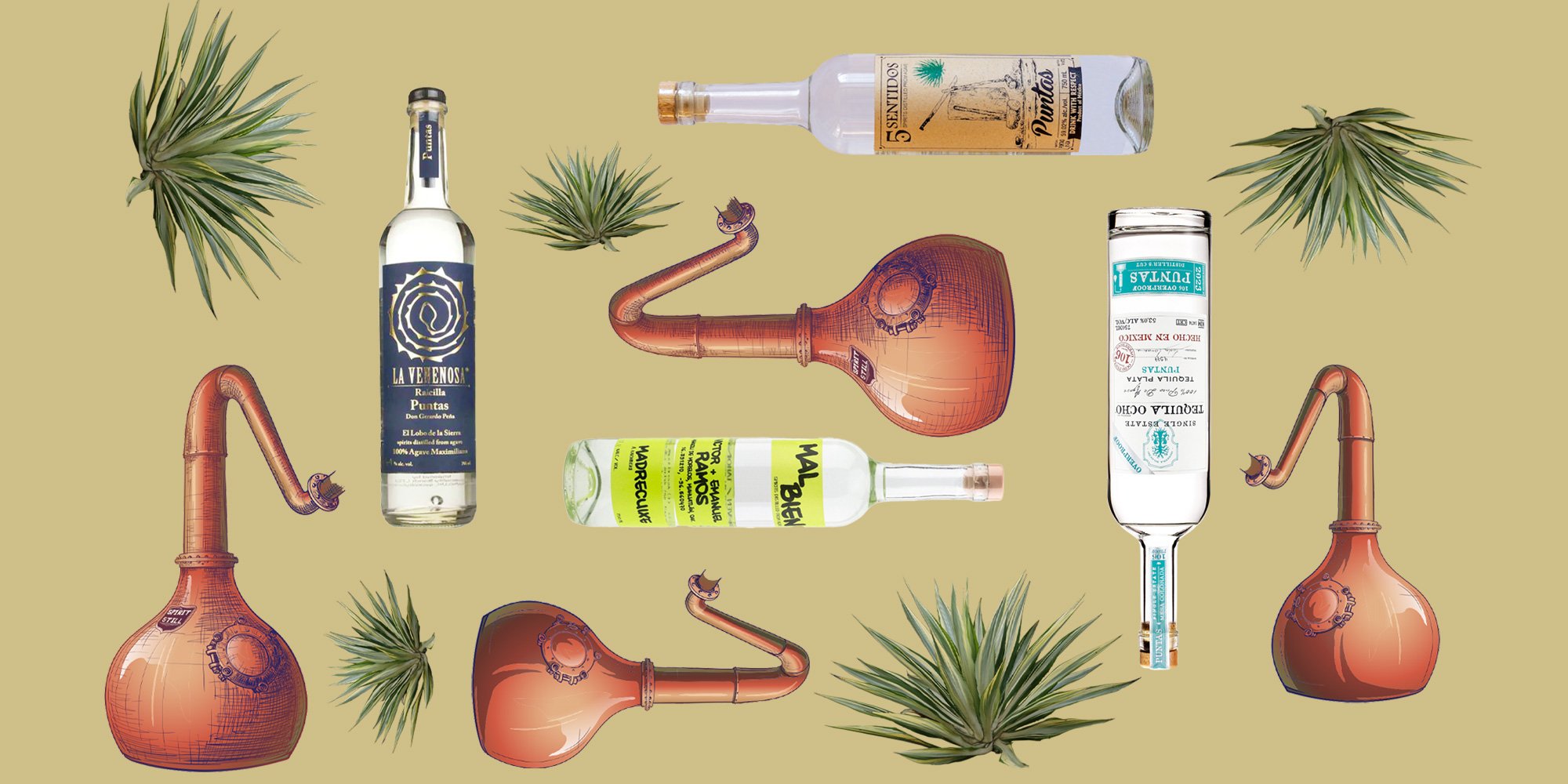
La Venenosa, raicilla Puntas
La Venenosa Racilla Puntas is the first example Arenstein recalls seeing on shelves, circa 2016. (While also agave-based, raicilla is not the same as mezcal or tequila.) Cinco Sentidos shipped its first batch of Puntas de Espadín to the U.S. market in 2021. Two years earlier, Mal Bien had started offering Madrecuixe Puntas, which the producer called “the platonic ideal that we imagine spirits to be. Agave, boiled down to its very essence, the plant stripped of everything but its soul.”
“This was always something we would produce at the distillery, ever since we started producing in 2007.”

Cinco Sentidos espadín Puntas
Arenstein finds all the puntas releases have a unique, specific taste. “You get almost a hand sanitizer note,” he says. “You put it on your hand and it evaporates like, you know, a hand sanitizer without lotion would. It has a lightness and kind of effervescence to it.”
If that doesn’t sound too appealing, there’s the somewhat taboo aspect of drinking puntas to consider. Haven’t we long been told that heads are solvent-y in taste and dangerous to drink — not only high in ABV but high in methanol content. And can’t that make you go blind?!
“If I’m pouring puntas for someone I will sometimes preface it with that,” Arenstein says. While a well-cut puntas is certainly safe to drink in small portions, Arenstein admits he has definitely encountered mezcaleros (distillers) with a cloudy-eyed look that has made him wonder, if not concerned.
The Distiller’s Cut
Admittedly, any concerns Arenstein has are not enough to stop him from drinking delicious examples of the style as more and more expressions hit the market. And it’s not just mezcal (and raicilla) producers now sending puntas expressions stateside.
“I think distillation can get really complicated and geeky to the average person,” Estes says, “so we wanted to help people understand what makes this different and unique and special.”
The first release, produced from agave from the La Ladera estate, and distilled at La Alteña, which has been the Camarena family’s distillery since 1937, was cut at 64 percent ABV, though diluted with water to 101 proof. (While a traditional mezcal puntas would never be diluted, tequila can’t legally be bottled in America at higher than 110 proof or 55 percent ABV.)
It quickly became a cult hit, well reviewed on sites like Tequila Matchmaker where it currently scores a crowd-sourced average of 90 among the site’s community. It was also most mainstream tequila drinkers’ first introduction to the old mezcal term puntas. (In Jalisco, distillers use the more literal translation for heads: cabezas.)
“There’s bad borrowing that’s happening from the mezcal world and there’s some good borrowing. And in a way this feels like a good borrowing,” Arenstein says, referring to Ocho’s use of the term. (Estes is quick to note that Camarena’s great-grandfather was making what was known as “vino de mezcal” well before tequila was even a term or category.)
https://vinepair.com/articles/puntas-traditional-mezcal-on-the-rise/
