PM Spirits

Provider of Geeky Spirits

Interview,la Quintinye,la Quintinye,la Quintinye

BRANDY - From Cognac to California, the historic spirit’s influence runs deep.

Interview, L'Encantada, Cognac Frapin, cognac, Cognac, Brandy, ImbibeNicolas Palazzi

JUICY FRUIT

From vineyard or orchard to bottle and bar, brandy’s influence runs deep.

Cognac, Armagnac, applejack, schnapps—in whichever form brandy is found, these spirits made from fruit have no parallel in the glass. While whisk(e)y, tequila, and rum get lots of love these days (deservedly so) from cocktail lovers and spirits drinkers, brandy is evolving and emerging on its own terms, slowly building a fan base to take this timeless spirit into the future.

We’re taking a closer look at today’s world of brandy—the ways it’s made and appreciated around the world, the details behind its complex production, and the reasons it should be the next bottle you reach for when cocktail hour rolls around.

Nicolas Palazzi

Bordeaux-born and Brooklyn based, Palazzi is the importer behind PM Spirits, specializing in independent spirits such as L’Encantada Armagnac, Cognac Frapin, and Cobrafire eau-de-vie de raisin.

“Something that’s really cool is when you’re in a brandy cellar, with 50, 60, 100 casks in front of you; even if they’re from the same batch of distillation, every cask is its own world. You could taste 15 casks distilled the same day, and you’ll find tremendous differences between them—whereas something like bourbon would be very consistent. There’s so much aroma and flavor profile available in brandy. If someone thinks Cognac is just one thing and it’s boring or they don’t like it, I assure you, I can find a single-cask Cognac that’ll blow your socks off. It’s a world that deserves to be discovered, for sure.”

https://www.dropbox.com/s/mel2ts24hjap0oq/MA22-Imbibe-Brandy.pdf?dl=0

Commanders and Cocktails!

Best of, cocktails, Interview, Jacky Navarre, Laurent Cazottes, Nouaison Gin, Pere Labat, NETA, Navazos PalazziNicolas Palazzi

Welcome to COMMANDERS AND COCKTAILS!

Some folks know that before I was able to work full time in comics, I worked in a variety of jobs in the wine and spirits field. And the final one of those was for my good friend Nicolas Palazzi’s PM Spirits. Just COMMANDER IN CRISIS, PM works its ass off to be unique, to create trends rather than follow them, and offer craftsmanship and creativity in a field that has, at times, been known to stagnate. I wouldn’t be where I am, writing this, without the support of friends and employers like Nicolas.

So, I thought it would be fun to turn the tables and feature him and his crew below, offering some in-universe cocktail recipes to honor the heroes of the Crisis Command. In the paraphrased words of a greater power, when I left PM I was but the learner. Now, I am the master (well, or closer to it)! And either way, I’m happy to return the support with a feature here, and invite creatives from other fields into the world of the Crisis Command.

STEVE ORLANDO

Commanders in Crisis, Vol. 2

PRIZEFIGHTER

2oz Navazos Palazzi Malt or Corn Whisky
0.75oz La Quintinye Rouge Vermouth
0.5oz cherry liqueur
2 dashes Angostura Bitters
Barspoon Absinthe

Instructions:

Build in rocks glass over ice and stir briefly. Garnish with burnt blood orange peel.

SEER

2.5oz Neta Espadin Destilado de Agave
0.5oz La Quintinye Dry
Barspoon of olive brine
Pinch of salt

Instructions:

Build in mixing glass over ice and stir until cold. Strain into chilled cocktail glass and garnish with 3 green olives on a pick.

SAWBONES

2oz Père Labat Rhum Blanc 59%abv
4 dashes Peychaud’s Bitters
Sparkling mineral water

Instructions:

Pour Rhum into highball glass over ice. Stir briefly to chill. Top with sparkling water and bitters. Stir once again to combine. Serve without garnish. or Neat pour of Jacky Navarre Cravache d’Or Cognac

ORIGINATOR

1oz Nouaison Gin by G’Vine
0.75oz lemon juice
0.5oz Laurent Cazottes Folle Noire
0.5oz simple syrup
2oz sparkling wine

Instructions:

Build all ingredients except sparkling wine in a shaker and shake lightly to combine. Add sparkling wine to the shaker and strain into chilled cocktail glass. Garnish with a spring of fresh lavender.

FRONTIER

2oz Père Labat Rhum Blanc 40% or 59% abv - Choose your strength
0.5oz Laurent Cazottes 72 Tomatoes

Instructions:

Build in mixing glass over ice and stir until cold. Strain into chilled cocktail glass and garnish with freshly ground black pepper.

COCKTAIL CREDITS: David Yi-Hsian Dong and Nicolas Palazzi of PM Spirits.

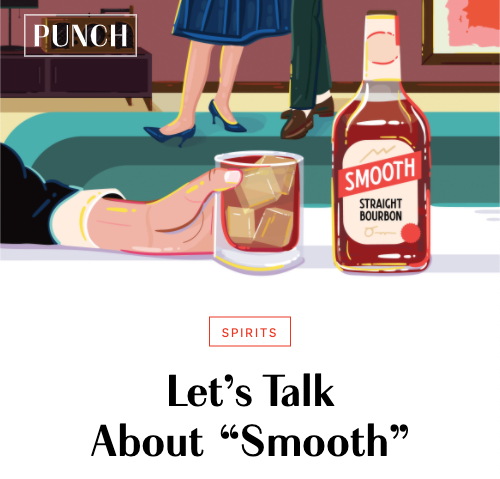
Let’s Talk About “Smooth”

Interview, Nicolas Palazzi, PM SpiritsNicolas Palazzi

It may be the most ubiquitous descriptor in drinks. Is it also the most reviled?

The Bordeaux-bred, Brooklyn-based spirits importer Nicolas Palazzi traffics in stories—of the alchemists along the river Charente, whose Cognacs capture the essence of the surrounding vineyards and microbiota; of the artisans in northwestern France, whose Calvados express the nuance of dozens of cider apple varieties via a single bottle. Palazzi’s company, PM Spirits, identifies itself as a “provider of geeky spirits.” Part of the job, indeed, involves geeking out, luxuriating in the details and conveying them to potential buyers. It’s an arrangement that hinges on dialogue, governed by the imprecise linguistics of wine and spirits. Descriptors and analogs form bridges to connect one’s palate and sensibility to another’s. But all it takes is one word to dissolve the connection entirely.

“If their reaction is, ‘Oh, that’s smooth,’ it just tells me that I probably have not identified my customer as well as I thought I had,” Palazzi tells me. “I’m not upset at the person saying ‘smooth.’ I’m upset at the waste of life—it’s basically a sign that says ‘You just wasted your time.’”

Harsh words for a word that literally signifies the opposite. But language matters. The lingua franca of booze is inherently nebulous, and it requires calibration. A trained nose and palate can instantaneously identify a range of aromas and flavors and free-associate memories and feelings, which all become pinpoints tracing a constellation, giving shape to a ghost. The term “smooth” effectively erases any point of reference. Even as an adjective, “smooth” functions as a verb: It is the buffing out of character, the sanding down of the distinctions that make great spirits great. In the quest to triangulate the specific qualities of a spirit, “smooth” instead forms a binary of acceptability. It is a value judgment on whether or not one finds the spirit drinkable, one that can easily be impressed upon an unwitting consumer. This is exactly why the term is so ubiquitous in the marketplace, and—for decades, if not centuries—a red flag among connoisseurs.

https://punchdrink.com/articles/lets-talk-about-smooth-whiskey-spirits-tasting-notes/

In Search of the Ultimate Freezer Martini

la Quintinye, martiniNicolas Palazzi
Screen Shot 2021-05-18 at 4.44.48 PM.png

We asked 10 of the world's best bartenders to submit their finest recipe for the pre-batched Martini—then blind-tasted them all to find the best of the best.

It’s been nearly a year since PUNCH conducted a new edition of the long-running “ultimate” blind-tasting series. In the age of COVID-19, such close gatherings of drink judges, sipping from successive versions of the same cocktail, all prepped by a guest bartender, were strictly a non-starter.

So, with COVID Nation still very much a thing, what drink could safely bring the series back to life? The prebatched, prechilled Martini, naturally. The prefab format of the classic—which was an established trend and served in many bars before the pandemic arrived—is perfectly suited to this new at-home era.

On a recent Monday, I was joined by PUNCH editors Talia Baiocchi and Chloe Frechette and bar owners Meaghan Dorman (Raines Law Room, Dear Irving) and St. John Frizell (Fort Defiance, Gage & Tollner) via Zoom to taste through 10 batched Martinis submitted by bartenders from the United States and England. The drinks had already arrived via contactless delivery. Judges were instructed to keep the mini-bottles in the freezer until tasting time.

Though batched cocktails can be controversial—many people are attached to the ritual of a bartender making their drink on the spot, particularly when it comes to the Martini—the panel convened with no prejudices. “We’re longtime fans of freezer Martinis,” said Frechette, who added that she thought batching was the way to prepare spirit-forward recipes during quarantine. Dorman agreed that premade drinks are an ideal fit for the current times, when most folks are entertaining at home for themselves and maybe a partner or roommate. “I think you should treat yourself right now and this is the way to do it,” she said.

This particular tasting brought to the table a few new variables that wouldn’t apply in a standard sampling of Martinis. Dilution had to be addressed anew. Since the cocktails are designed to simply be pulled from the freezer and poured, they weren’t receiving their dose of softening water through the usual spin in a mixing glass filled with ice. Instead, water was added directly to the batch and had to be precisely portioned out. Too much or too little could prove disastrous. One Martini in the running didn’t make the cut because the judges thought it too strong—i.e., lacked sufficient H2O. Another suffered from a surplus of added water, rendering it weak and, well, watery.

Temperature, too, was an important factor. Martinis are expected to be cold, naturally, but these freezer-born numbers were particularly icy—a consideration the bartenders had to factor in when choosing their ingredients and honing their ratios. “Martinis in this format dull the aroma and the alcohol comes forward,” explained Baiocchi.

That issue notwithstanding, the panel was surprised by the variety of character they encountered from one glass to the next. And, as would be expected in any sampling of signature Martinis, there were some odd flights of fancy. One recipe called for both sherry and peated Scotch; another included a hefty dose of absinthe. The judges didn’t necessarily dislike either drink; they simply didn’t read as Martinis.

Finding favor was a unique specimen submitted by Orlando Franklin McCray of Brooklyn’s Nightmoves, who put together high-proof, saffron-tinged Old Raj gin, La Quintinye Extra Dry vermouth and orange bitters. The judges liked the concentration of bold flavors but thought the recipe would have benefited from higher dilution.

With the vast changes in bar regulations brought on by COVID, Frizell said that he both hopes and expects to see more prebatched cocktails on the market when the pandemic recedes and bars fully reopen.

“My hat is off to the New York State Liquor Authority for the first time in my life, for freeing up the rules so quickly,” he said. “We’re able to do so many things now that we would have lost our license for before.”

For the time being, however, he’s doing what most every other cocktail lover has been doing for the past year: shaking up his own at home. “I’ve been drinking my own Martini almost every day,” said Frizell.

https://punchdrink.com/articles/ultimate-best-freezer-frozen-pre-batched-martini-recipe/

NEAL BODENHEIMER'S OLD HICKORY

vermouth, la Quintinye, recipeNicolas Palazzi

Mastering the Old Hickory With Neal Bodenheimer

The obscure vermouth classic gets retooled with an eye toward more flavor and less dilution.

The “raisinated vibe” and wormwood bitterness of La Quintinye Blanc forms one half of the 50/50 vermouth split.

The “raisinated vibe” and wormwood bitterness of La Quintinye Blanc forms one half of the 50/50 vermouth split.

If you’ve never heard of the Old Hickory, you’re not alone. A simple 50/50 mix of sweet and dry vermouths punched up with bitters, this low-proof classic has long existed in the shadow of the Bamboo and Adonis. Neal Bodenheimer wants to put it center stage.

Though he started workshopping the drink at his New Orleans bar Cure, he “really dug in,” as he describes the process, on the Old Hickory for Dauphine’s, a New Orleans–inspired bar and seafood restaurant slated to open this spring in Washington, D.C.. “It felt modern, and like things I wanted to drink,” he explains of the simple build. However, “it felt like a cocktail that never really got its due.”

Part of the New Orleans canon of cocktails, the Old Hickory first appeared in print in Stanley Clisby Arthur’s 1937 book, Famous New Orleans Drinks And How to Mix ’Em. Supposedly, “Old Hickory” was a nickname given to General (and later U.S. president) Andrew Jackson, a reference to his fortitude as he led troops through the Battle of New Orleans in the winter of 1814-15. Although Arthur writes that the drink was Jackson’s “favorite tipple,” Bodenheimer dismisses the claim: “I don’t think people were drinking vermouth in America in 1850.”

Though his vision for the Dauphine’s interpretation is a pre-batched version, Bodenheimer preserves elements of the cocktail-making ritual. The format coalesced at an event held at New York’s James Beard House in September 2019, intended as a preview for Dauphine’s. For the seated dinner with cocktail pairings, Bodenheimer sought out food-friendly pours, and the vermouth-forward Old Hickory seemed like a natural fit. Yet, stirred with ice, it felt too thin and watered-down. The solution was to pre-batch the vermouths and refrigerate the mixture until ready to serve. Bitters were stirred in at the last minute—“bitters expand in a batch over time, so I keep them out,” says Bodenheimer—and the mixture was then poured over a large ice cube and quickly served. The end result presented like a cocktail, but retained the texture of wine.

“We said, ‘What if we made it like an Old-Fashioned setup, and less like a vermouth cocktail?’” he recalls. “We always had our vermouth in the fridge anyway, so we always had a chilled vermouth bottle.”

https://punchdrink.com/articles/mastering-old-hickory-vermouth-cocktail-recipe-neal-bodenheimer-dauphines/

Geeky Cocktails: Meet the Man Behind the Artisanal Spirits Movement

cognac, Navazos Palazzi, PM Spirits, InterviewNicolas Palazzi
nicholas-pilazzi-cocktail.jpg
 
VOGUE_LOGOsvg.png
 

Geeky Cocktails: Meet the Man Behind the Artisanal Spirits Movement

When Nicolas Palazzi quit his day job as a chemical engineer in 2008, the spirits world got a little more interesting. The French native had moved to New York City to manage a medical research lab, but brought with him a curiously intense affinity for rare-cask Cognac. Dismayed by the lack of like-minded, handcrafted products on the market in the U.S.—where the spirits scene was still largely focused on big-name brands despite a booming, more intelligent cocktail culture—he set out to learn the business from the ground up. He officially launched his import company, PM Spirits, in early 2011 with just two independent Cognac producers (Paul Beau, Guillon-Painturaud) and six products. Now his book includes profound Spanish brandies, grappa from famed Sicilian avant-gardiste Frank Cornelissen, and Mexican Fernet (a bitter liqueur).

Palazzi is being lauded by beverage authorities nationwide as the go-to for distillates of character and terroir, and Palazzi’s unique bottles now line the shelves of restaurant and bar greats like The NoMad in New York City, Jack Rose Dining Saloon in Washington, D.C., and Scopa Italian Roots in Venice, California. Had an interesting digestif you’d never heard of before while out dining? That might have been made possible through Palazzi’s meticulous sourcing. He talks to Vogue.com about cocktails, “geeky” spirits, and the six bottles he’s most excited about now.

The tagline on your website is “provider of geeky spirits.” What does “geeky” mean in the spirits world?

When it comes to spirits in general, one doesn’t buy a product, one buys a brand. They buy the marketing and the status that the label conveys, but they don’t have a gauge on the true quality of the stuff inside the bottle, how it was made, who made it, and why it tastes the way it does. So by “geeky,” we mean the other stuff. It’s made by real people. It has an actual flavor profile that is specific to the place in which it’s made and the ingredients it’s made from. It’s not sweetened to death, artificially colored, or made to be as innocuous as it can be.

From that perspective, it seems to be as much about supporting the little guy as it is about supplying cool products.

It absolutely is. We want them to keep doing what they’re doing. When you start working with somebody, and they’re distilling out of a shack or their house is run-down, and you come back a year and a half later and see that they’ve made improvements. . . I’m not saying it’s 100 percent because of what we’ve done, but there is something rewarding about working with real people and the fact that the money spent buying these products can go toward their living and the creative process as opposed to feeding some giant company. I have nothing against big companies, but that makes it more meaningful to me. And the other result is that we’re educating people; we’re getting the authentic stuff to the people who will care about it. We’re showing them what these spirits used to taste like before mass marketing existed and can still taste like today.

What is a typical reaction of someone tasting spirits in your portfolio who is more used to tasting name-brand products?

People are not sure what to expect. A lot of people start out thinking that they’re doing us a favor by tasting these products that they’ve never heard of before, but they end up realizing that there’s a world of difference. I had one buyer who thought he didn’t like Cognac, then after one taste of the Paul Beau VS, he lit up. He was all, “Oh, wow, that’s really interesting,” and, “That’s a set of aromas and flavors I’ve never experienced before.”

There’s something extra that happens in the brain with the sensory experience of taste. When you taste something new and you love it, there’s an emotional connection that takes place. At that point, the person is not likely to forget it. They know you’re not fooling around and will want to see what else you have in your bag, even if it’s not something that will appeal to their particular clientele. They know you’re not wasting their time.

Would you say that the movement toward artisanal spirits is picking up speed, like what we saw happen to the craft-beer category?

It has definitely changed over the last six or seven years. Before, nobody cared, really. If you take bourbon as an example, you used to be able find anything you’d want and more on the shelves for a lot less money because people just didn’t know about it. And now certain bourbons are unavailable and allocated. Spirits are becoming cool. Drinkers have started paying more attention to what they’re drinking. I think that’s good news for everyone involved.

What is the coolest cocktail that you’ve encountered made with one of your spirits?

In Texas, I saw a sidecar made with a single-cask Cognac from a producer named Gourry [de Chadeville] that I brought in last year. This Cognac is distilled in a wood-fired pot still and is 64.3 percent alcohol, so that is a pretty kick-ass sidecar. You can’t drink too many of them! And at Cane & Table in New Orleans, they’re making a daiquiri with a rum I sourced in Spain from the sherry producer Equipo Navazos. It’s a bold daiquiri and is totally delicious.

What’s the latest addition to your portfolio that you’re most excited about? The thing that we don’t know about yet but will?

Calvados! I was lucky enough to be introduced to Eric Bordelet, the cider-maker in Normandy. It turns out the guy has been distilling for a number of years but never released anything. He’s doing single-cask full-proof unfiltered Calvados, distilling from both his cidre and his poiré (pear cider). Plus, his mentor was Didier Dagueneau, the famed Pouilly-Fumé winemaker, so everything is aged in ex-Silex casks from Dagueneau. It’s incredibly cool and will be available stateside in the beginning of 2016.

Intrigued? Here are six unique bottles Palazzi recommends adding to your bar (or gifting a very good friend):

Navazos-Palazzi Double Barreled Cask Strength Spanish Rum
A 100 percent molasses-based rum from the Antilles. Dark, meaty, with a nuttiness derived from the Oloroso sherry cask it ages in for more than ten years. Finishes bone dry. Only 1,500 bottles produced per year.

H. Beudin Single Cask 18 Year Calvados
Calvados with a kick, bottled at full proof. Gives a sense of what the pure stuff tastes like when sampled from a cask. Selected by star cider-maker Eric Bordelet.

Gourry de Chadeville Grande Champagne Cognac
One-man operation led by Pierre Goursat Gourry on nearly 25 acres of vineyards in Grande Champagne. A young, bold Cognac reminiscent of ripe apple and smoke, it spends seven years in an ex-first growth Sauternes cask.

Domaine d'Aurensan 1975 Single Cask Armagnac-Ténarèze
Like a vintage-dated Armagnac on steroids, with zero sugar, zero water, and zero coloring added. Distilled by the Rozès family. Mature flavors of dried prune, leather, and earth, with a seemingly endless finish.

Laurent Cazottes Poire Williams Eau-de-Vie
Distilled from organic pears dried to concentrate their flavor and then the pits, seeds, and stalks removed. Only 200 half-bottles of this Poire Williams come in to the U.S. each year.

Frank Cornelissen MunJebel Rosso Grappa
What happens when Sicily's most emblematic natural winemaker makes grappa. Distilled in a wood-fired vapor still from volcanic Mt. Etna’s indigenous Nerello Mascalese grapes.

https://www.vogue.com/article/man-behind-artisanal-sprits-top-picks